How to Review Overtrading Patterns: An Effective Guide to Traders who want consistency
The majority of traders do not notice that they are overtrading until it is too late. It is not always so obvious - sometimes it is hidden behind active trading or the desire to cover the losses. What if your biggest losses are not because of trades but because you are trading too much too quickly and without a clear plan? The fact is, overtrading is not a strategy issue - it is a pattern issue. And patterns may be monitored, measured and corrected. Learning how to review overtrading patterns with a correct trading journal may be the turning point you did not know you needed.

Kaushal Chhaunkar
May 14, 2026
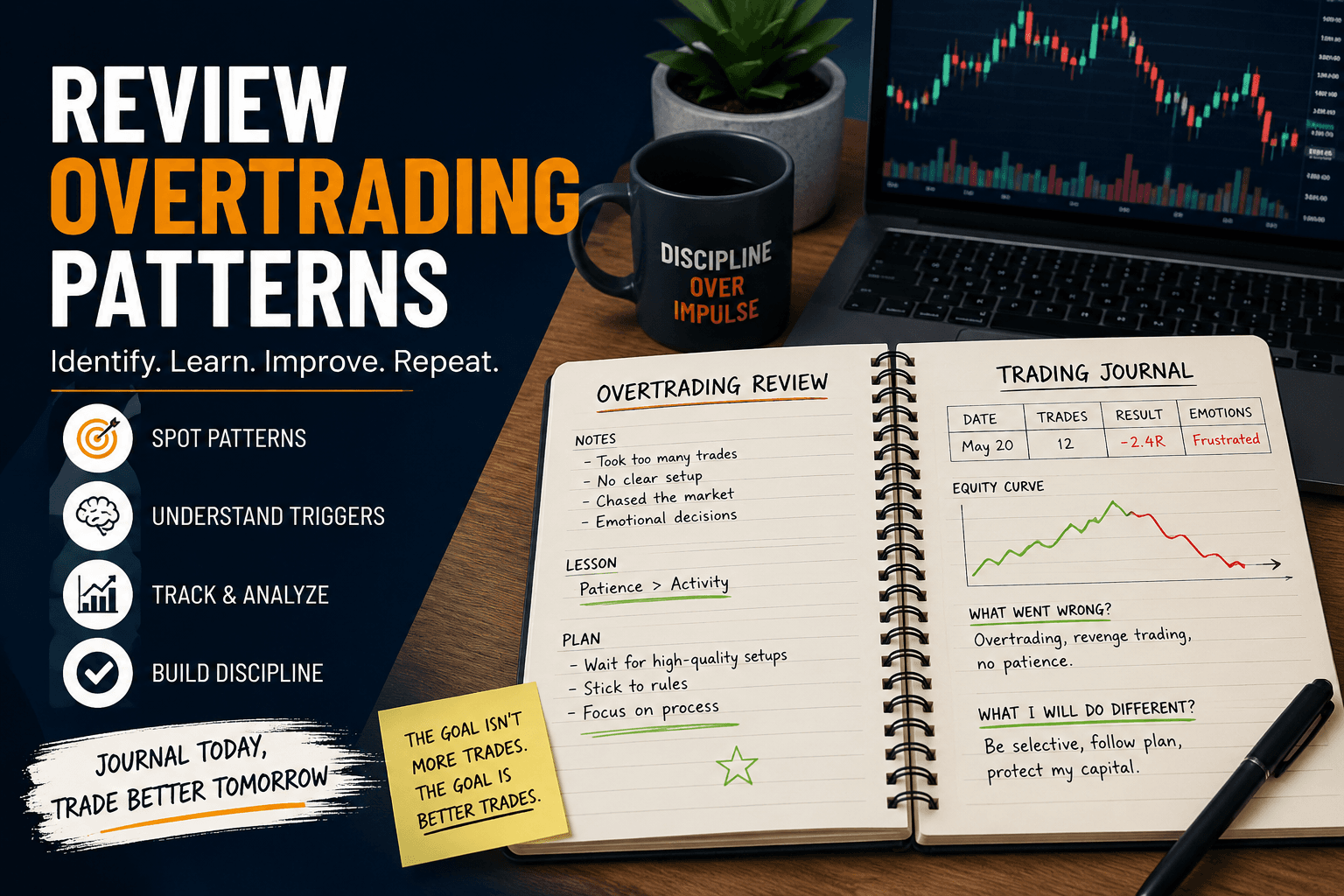
What Is Overtrading and Why It Occurs.
The whole concept of overtrading is not necessarily about excessive trades. It is about making trades without obvious purpose, discipline, and consistency.
To put it simply, overtrading occurs when:
You take trades out of boredom
You attempt to cover losses in quick time.
You come in without a proper setup.
You continue trading even after your plan is done.
This becomes a silent practice to many traders. It looks not wrong at the time but in the long run, it is slowly harming performance.
The biggest problem is not the number of trades made behind it but the fact that it has no control over it.
The reasons why overtrading is tricky to identify
Most traders do not relax and tally the number of unnecessary trades that they make.
They instead concentrate on:
Total P&L
Winning or losing days
Market direction
But overtrading lies within these figures.
Overtrading can be part of a profitable day.
It is possible to have an entire day of losing which is completely due to additional trades.
It is hard to distinguish between good and impulsive trades unless they are properly tracked.
This is the reason why a systematic journal of stock trading becomes a necessity.
Role of a Trading Journal in detecting Overtrading
A trading journal is used not only to document trades. It helps you in seeing your behavior as time goes by.
Once you keep a record of the trades, you start to notice a pattern:
What number of trades you make a day.
What are some of your trades?
What are the impulsive trades?
It can be done with the help of a good trading journal app that can help to categorize the trades and help the trader to look through the trades clearly.
Step-by-Step: How to go over Trading Patterns of Overtrading
Step 1: Track the Number of Trades Per Day
Start with a simple measure: What number of trades do you do in a day?
Look at:
High-activity days
Low-activity days
The days when the losses increased after several trades.
This fundamental tracking can tell a lot.
Step 2: Planned vs Unplanned Trades
Trades are not all equal.
You can divide your trades into two:
Planned trades (based on strategy)
Impulsive or emotional trades (unplanned trades).
A trading log helps you to label or identify these trades.
With time you can see: The majority of the losses are due to unplanned trades.
This is considered as one of the best indicators of overtrading.
Step 3: Trade Timing analysis
Overtrading tends to occur at certain times.
Look at:
After a big loss
After a big profit
When the market is slow.
Near market closing
You can get patterns such as:
Overtrading after 2 PM
Unplanned trading on crossways markets.
The timing patterns mentioned can be identified with the assistance of a detailed day trading journal.
Step 4: Review Emotional Triggers
Emotions are closely tied with overtrading.
Ask yourself:
Was it out of frustration I traded?
Was I making an attempt to recoup losses expeditiously?
Was I pursuing missed opportunities?
Such emotional triggers are often repetitive.
An appropriate stock trading journal with notes in it helps you in relating behavior to results.
Step 5: Ensure The Quality of Trade and not the quantity
It is not necessarily bad to take a lot of trades, but bad ones are bad.
Review:
Was the arrangement evident?
Was it according to your strategy?
Was the risk defined?
When the majority of the trades do not match your standards, this is one of the symptoms of overtrading.
Common Patterns of Overtrading Traders Miss
Revenge Trading
Once you have lost, you will just take another trade as a recovery measure.
Overconfidence Trading
You maximize profits, and you trade more frequently without appropriate arrangements.
Boredom Trading
In a slow market you coerce trades just to keep the market moving.
Late Entry Trading
You chase trades when you fail to make the first move.
These patterns recur unless they are followed.
The role of Technology in the process of reviewing overtrading
Initial tracking can be done by manual tracking wherein notebooks or a trading journal excel sheet is used. However, it is hard to review patterns with time.
Nowadays, such aids as a trading journal website or automated system make the process easier.
An automated trading journal free tool can:
Monitor frequency of trade automatically.
Highlight high-activity days
Show patterns over time and performance.
Reduce manual errors
This is much more effective to review overtrading.
How BazaarDiary Can be used to detect overtrading patterns
BazaarDiary is designed to be more than mere tracking. It helps traders to perceive their actions in a clear way.
The most important characteristics that help:
Automatic trade tracking
Trade count (daily and weekly).
Time- and strategy-based performance.
Marking system of types of trade.
Psychology tracking
Simple Weekly Overtrading Review Procedure
You do not require a complicated process. Each weekend, evaluate your trades with the following questions:
What was the number of trades that I made per day?
Identify high-frequency days.
How many trades were outside my plan?
Count impulsive trades.
Which are the most common periods of time when overtrading occurred?
Time-based analysis.
Was my decision affected by emotions?
Search for patterns.
What will I do next week?
Set one clear rule.
Mistakes to Avoid while Reviewing Overtrading
Ignoring Small Patterns
Even 1-2 additional trades per day may have an impact.
Concentrating on the losses only
Even on profitable days there can be overtrading.
Not Being Honest
Accept it, if it was an emotional trade.
No Action Plan
Inaction review leads to no improvement.
From Overtrading to Controlled Trading
It is not to trade less but to trade better. As you start to look over your patterns:
Trade quality improves
Emotional decisions reduce
Confidence becomes stable
Performance becomes consistent
A structured best online trading journal helps in transforming a random activity to a controlled execution.
Final Thoughts
One of the most common, but ignored, trading issues is overtrading. It is not the result of lack of knowledge, but it is the result of lack of awareness. Patterns start emerging the moment you come to monitor and review your trades in a proper manner. And when patterns start to be seen then they can be rectified. It doesn’t matter whether you are using a notebook, Excel or a modern trading journal app, the point is you have to be consistent and honest.
If you want faster insights and less manual work, a system like BazaarDiary can make the process easier and more efficient.