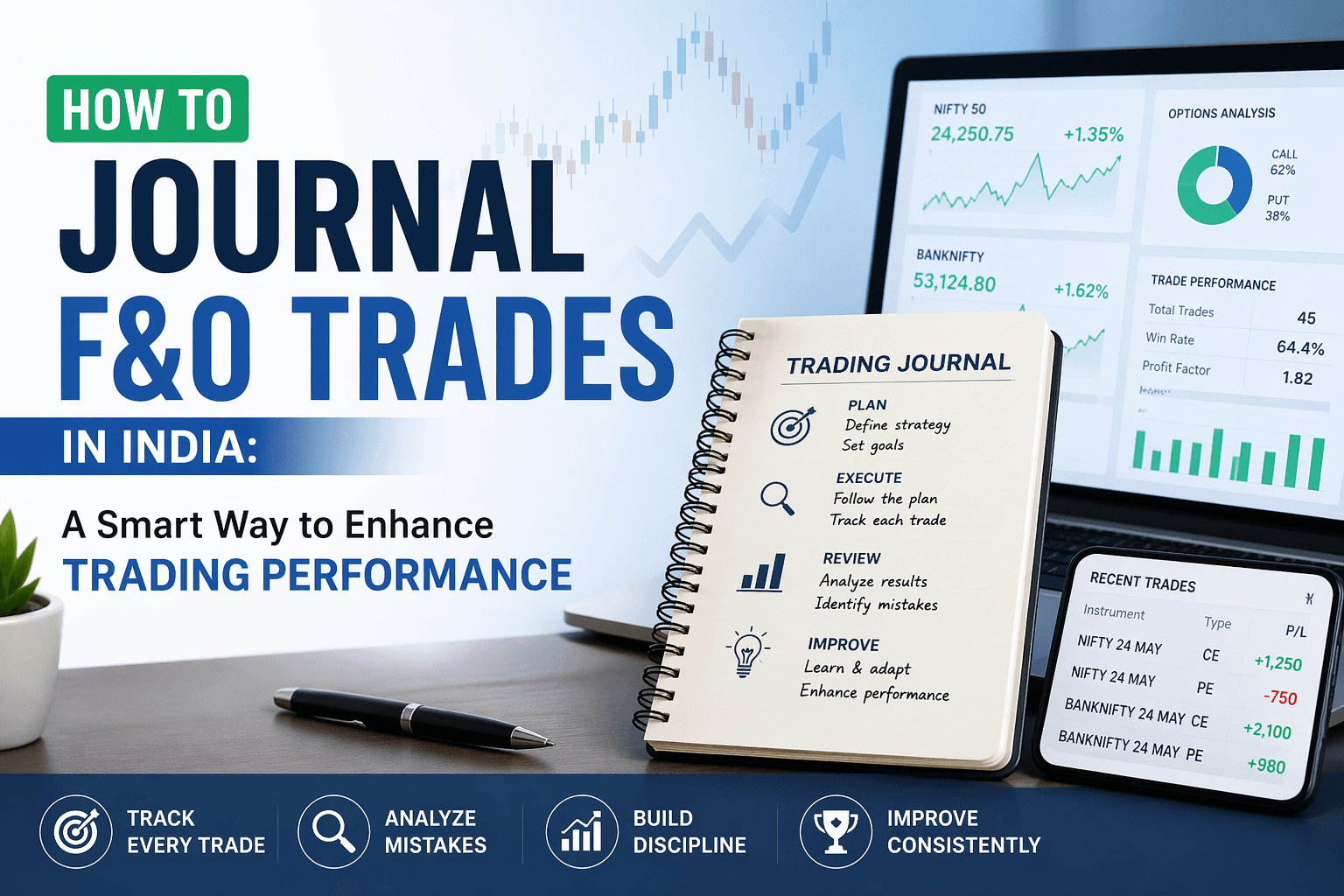
How to Journal F&O Trades in India: A Smart Way to Enhance Trading Performance
The majority of F&O traders in India focus on when to enter and exit trades and the direction of the market but very few traders track why they make profits and losses. That is where the difference between trading and consistent trading starts. A good record of trades can show patterns in timing, strategy, risk-taking and even feelings that are hard to see when markets are moving. Imagine knowing which trades work for you when you do best and what mistakes you keep making. If you trade options or futures and want to do more than just guessing, learning how to journal F&O trades the right way can completely change how you approach the market.

Kaushal Chhaunkar
April 23, 2026
Why Traders in India Need to Record F&O Trades
Trading futures and options is very active in India. Every day, thousands of traders sell Nifty, Bank Nifty, stocks and expiry-based setups. But many traders keep repeating the cycle:
Make a good profit one day
Lose money the next day
Make emotional decisions after losing money
Have no clear idea what actually works
This happens because most traders do not track their trades properly or at all.
A good trading journal helps turn activity into progress that can be measured. By relying on memory it creates a system where every trade teaches something valuable.
That is why serious traders now think journaling trades is as important as analyzing charts.
What Does It Mean to Record F&O Trades?
Journal F&O trades means writing down and reviewing every detail of your futures or options trades. It is more than writing.
A good record also tracks:
Why you entered the trade
Why you exited the trade
The risk you took
The market conditions
The mistakes you made
How you felt during the trade
This turns a stock trading diary into a tool for growth.
Why Most Traders Fail at journaling Trades
Many traders start journaling trades with enthusiasm but stop after a day.
Common reasons
Using notebooks or trading journal excel sheets gets tiring.
Traders make random notes in an unstructured form.
Information is gathered but not analyzed.
They record profit and loss. Not behavior.
A journal without review is just storage.
What to Record in Every F&O Trade
If you trade options or futures in India these details matter the most.
Basic Trade Details
Date
Instrument (Nifty, Bank Nifty, Stock Option, Future)
Sell
Entry Price
Exit Price
Quantity
Profit or Loss
This creates the foundation of your trading log.
Strategy Used
Examples:
Breakout
Reversal
Trend follow
Scalping
Expiry premium decay setup
After trades you will know which setups actually work.
Time of Trade
Time matters heavily in F&O.
Opening volatility
Midday slowdown
Closing moves
Expiry spikes
A good option trading journal often reveals that some traders perform best during specific hours.
Risk Management
Track:
Stop loss planned
Stop loss followed or not
Position sizing
Risk-reward ratio
Many traders lose not because of entries. Because of poor risk control.
Psychology & Emotions
This is where real growth happens.
Write:
Fear before entry
Overconfidence after profit
Revenge trading, after loss
Impulsive re-entry
A proper trading diary shows mistakes faster than market losses do.
How to Journal F&O Trades Step by Step
Step 1: Write Down Trades Right Away
Do not try to remember everything after the market closes. Write down all the details soon as the trade is closed or use a trading journal app that does it for you automatically.
Step 2: Mark Mistakes Clearly
Some examples are:
You got in early
Ignored stop loss
You traded too much after losing
You made a bad trade
When you keep making the same mistakes they can cost you a lot of money.
Step 3: Review Every Week
On the weekend ask yourself:
Which trade worked out the best?
Which day was the worst?
What mistake did you make because of your emotions?
Did you follow the rules to manage your risk?
This is where keeping a journal really helps.
Using Excel vs a Modern Trading Journal for F&O Traders
A lot of traders in India start by using spreadsheets, which's okay. Excel gives you a lot of flexibility but after a while it can be annoying:
You have to enter everything by hand
Formulas can get messed up
You might forget to update it
You do not get any insights into your behavior
That is why a lot of traders switch to an online trading journal or a trading journal website just for trading journals.
These new tools can automatically import your trades, make reports and help you review faster.
Why Automation is Important in India
F&O traders in India often make a lot of trades in one session. Writing down everything after 8-10 trades can be really tiring. An automated trading journal free solution can save you time by:
Importing trades automatically
Tracking your profit and loss
Showing how well you do with each trade
Reducing mistakes
You get better when you do not have to work so hard.
How BazaarDiary Can Help F&O Traders
BazaarDiary is made to make it easier for Indian traders to keep a journal. Instead of writing everything by hand, it helps you make a complete system. Some useful features for F&O traders are:
Auto-sync with your broker
A calendar of your trades
Tagging your strategies
Tracking your win rate
Notes on your psychology
Insights from Edge Finder
Best Questions to Ask Yourself Every Week
Use these every Sunday:
How did you do?
What was your total profit or loss for the week?
What was your best day?
What was your worst day?
How did you behave?
Did you trade much?
Did you break your stop losses?
Were you emotional after losing?
What about your strategy?
Which trade worked out the best?
Which instrument was the best for you?
These questions make your futures trading journal really helpful.
Mistakes to Avoid When Keeping a Journal
Only Writing Down Winning Trades
You can learn more from your losses than your wins.
Not Being Honest
If you made a revenge trade, write that down.
Trying to Make Your Journal Perfect
Simple and consistent is better than fancy and incomplete.
Never Looking Back
If you do not review you cannot get better.
From Random Trades to Consistent Results
A lot of traders think that success comes from finding a strategy. Really success comes from:
Doing what works over and over
Stopping what does not work
Managing your emotions
Following the rules to manage your risk
A journal can help you with all of these things. That is why the best traders think that looking back is just as important as making trades.
Final Thoughts
If you trade F&O in India keeping a journal is not optional anymore. The markets move fast, your emotions move faster. Your memory is not reliable. A good trading journal helps you slow down, look at your decisions and get better using data of guesses.
You can start with Excel, notes or a simple log. But if you want to be consistent, use automation and get insights, a system like BazaarDiary can make it a lot easier.


